
The challenge
Manchester needed its main steam and condensate piping replaced, from the boiler plant out to Building 1, and the steam distribution piping throughout the main building. The hard part wasn't the design. It was access. A long stretch of the run lived inside a 500-foot subbasement utility tunnel, classified as a confined space, threading directly beneath occupied offices and patient-care areas. In places it was just four feet high. You can't responsibly design a piping replacement for a space like that off decades-old as-builts, and you can't send people crawling through it repeatedly just to take measurements.
What we did
Alares provided the full design package: replacement of the main steam and condensate piping from the boiler plant to Building 1, replacement of the steam distribution piping throughout the main building, plus the electrical and fire-protection engineering, coordination with civil and asbestos testing, and complete construction drawings, specifications and cost estimates. To do it accurately, we documented the existing conditions with remote surveying and 3D scanning instead of bodies in the tunnel.
How we did it
A robot in the tunnel
We deployed a remote-access vehicle fitted with a three-camera system and drove it the length of the tunnel, capturing detailed video of every steam trap, valve and critical component. That footage became the basis for the design, and it did something else valuable: we handed the tunnel videos to contractors during bidding, so they could price the work against what was actually there instead of padding their bids against the unknown.
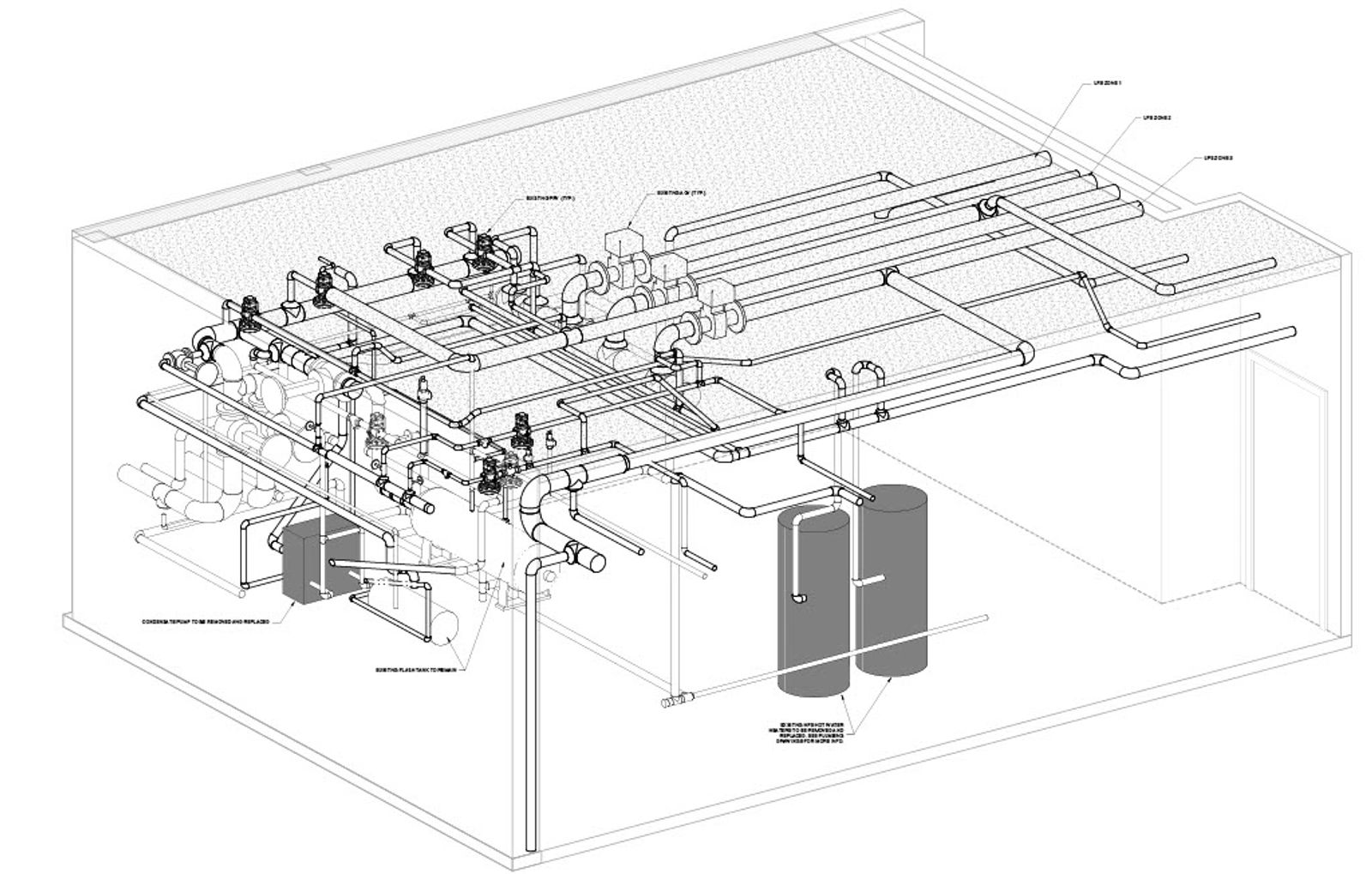
A measured model of the mechanical room
For the dense, complex arrangement of piping and valves in the mechanical room, we used 3D scanning to build a detailed Revit BIM model, then walked the space on site to confirm and label every pipe and valve. Integrating that model into the design documents took the ambiguity out of the drawings, which is what keeps change orders down once construction starts.
The outcome
Manchester got a modernized, reliable steam distribution system. Because the design was built on verified conditions, the documentation was accurate, the bids came back competitive and realistic, and the remote-survey approach meant nobody had to enter a four-foot confined space to get there. It's a clean example of how the right survey method, chosen for the constraints of the site, de-risks the entire job.